Open Source and Open Science in Latin America
Originally published at metadocencia.org (in English)
Co-authored with Laura Ación and Fernando Pérez. Translated to Spanish and Portuguese by Laurel Ascenzi and Melissa Black.
This post is an extended write-up of a panel held during the 2021 CZI Essential Open Source Software for Science (EOSS) meeting, with Laura Ación and Gonzalo Peña-Castellanos, moderated by Fernando Pérez. The authors added additional context and covered topics that time constraints prevented during the panel discussion.
The motivation for this panel was to explore aspects of Open Source and Open Science development processes and communities in Latin America, specifically Argentina and Colombia. Scientific Open Source development tends to be dominated by activity from North America and Western Europe. The authors argue that the real promise of open science lies in offering "not only access, but agency as first-class participants and co-creators, to people from all nations."
The authors emphasize they present limited perspectives based on their own countries' experiences, noting that "Latin America is a large, rich and diverse continent with huge cultural diversity."
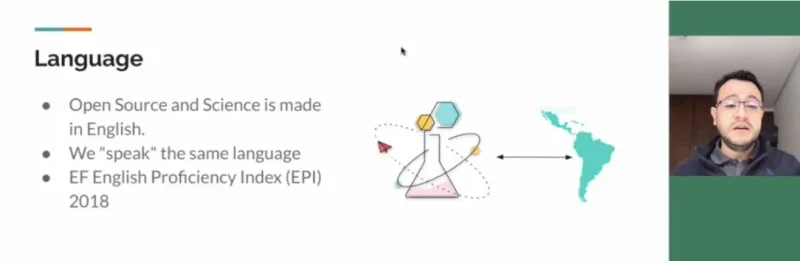
Localization and the role of English as interchange language
Both authors addressed language localization as a tool to broaden Open Science reach in Latin America. However, translation is laborious and scientists need English fluency. Why still support translation despite these issues?
Laura's Response:
"Because, until we all can afford the time and money to learn English, I see no other way to make science inclusive."
She argues that language barriers prevent humanity from learning collectively from one another. She advocates for language interpretation at conferences as an affordable tool for high-income countries, enabling diverse speakers.
Gonzalo's Response:
Gonzalo compares language translation support to Django Girls programs targeting women in tech. He explains: "The argument of a scientist must know English, then no need to translate anything is strong but is also exclusionary to anyone not a scientist."
He argues that excluding non-English speakers limits science advocacy and literacy broadly. Such initiatives are "temporary hacks" until systemic change occurs, but necessary for meaningful inclusion.
Barriers beyond language
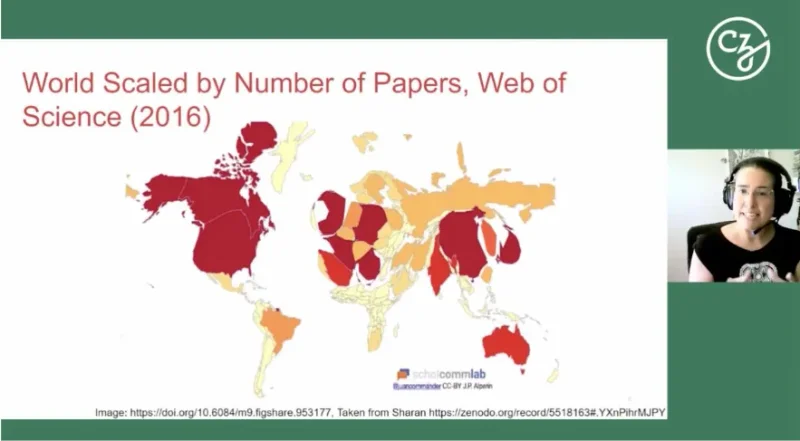
Beyond language, what other barriers exist for Open Source and Open Science communities in Latin America?
Laura's Response:
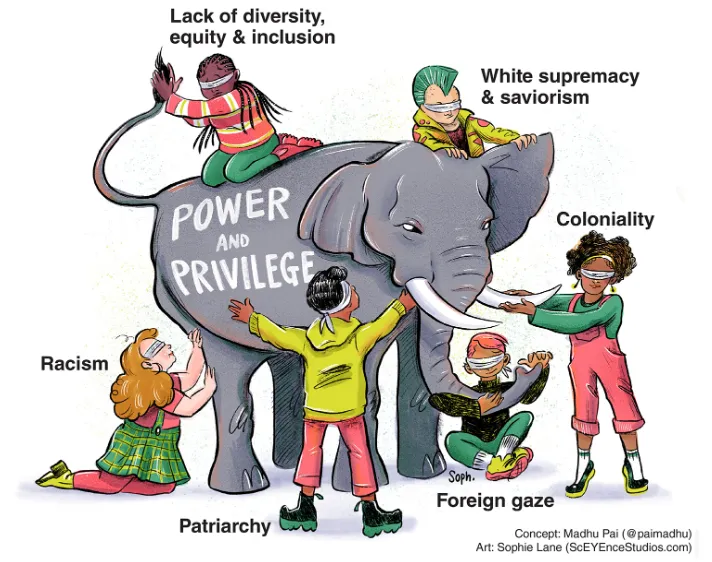
The "current power and privilege asymmetry between Latin America and high-income regions is the main barrier." She notes everything reduces to "money or time." Local contexts present challenges that outsiders struggle to understand.
Additional barriers include:
- Lack of incentives for Open Source and Science in academia
- Power asymmetries in global Open Science paradigms
- Limited recognition for non-publication activities (data collection, code maintenance, community building)
Gonzalo's Response:
Infrastructure represents a critical barrier: "lack of access to the internet, this means stable, reliable and with good speed 24/7 access."
He notes multiple groups work on similar issues but lack collaboration mechanisms.
Growing Open Source Science as a global endeavor
What are concrete ways to make Open Source and Science genuinely global?
Gonzalo's recommendations:
- "We need ALL curriculums to include an introduction to programming"
- "We need bilingual education from primary school all the way up"
- "We need full infrastructure coverage"
- "We need funding bodies to also fund research devoted to the creation of software as the main goal"
- "We need to unify efforts across the continent, not only by collaborating in research and research grant applications but at the community level"
- "Before we can make things global, we need to make it local"
Read the full essay at metadocencia.org.