Open Source and Open Science in Latin America
Originally published on metadocencia.org (in English)
Co-authored with Laura Ación and Fernando Pérez. Translated to Spanish and Portuguese by Laurel Ascenzi and Melissa Black. Images: Julián Buede.
This post is an extended write-up of a panel held during the 2021 CZI Essential Open Source Software for Science (EOSS) meeting, with Laura Ación and Gonzalo Peña-Castellanos, moderated by Fernando Pérez. The authors added additional context and covered topics that time constraints prevented during the panel discussion.
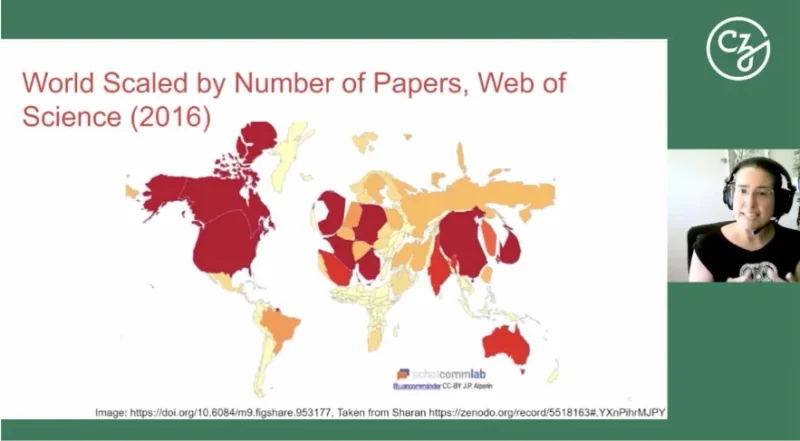
The motivation for this panel was to explore aspects of Open Source and Open Science development processes and communities in Latin America, specifically Argentina and Colombia. Scientific Open Source development tends to be dominated by activity from North America and Western Europe. The authors argue that the real promise of open science lies in offering "not only access, but agency as first-class participants and co-creators, to people from all nations."
The authors emphasize they present limited perspectives based on their own countries' experiences, noting that "Latin America is a large, rich and diverse continent with huge cultural diversity."
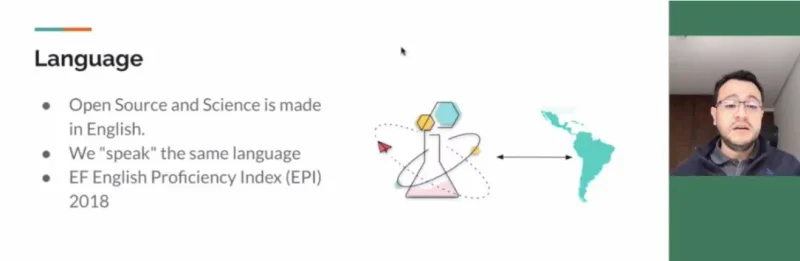
Localization and the role of English as interchange language
Both authors addressed language localization as a tool to broaden Open Science reach in Latin America. However, translation is laborious and scientists need English fluency. Why still support translation despite these issues?
Laura's Response:
"Because, until we all can afford the time and money to learn English, I see no other way to make science inclusive."
She argues that language barriers prevent humanity from learning collectively from one another. She advocates for language interpretation at conferences as an affordable tool for high-income countries, enabling diverse speakers. She highlights how "reading captions is a relatively easy habit to incorporate with a huge impact" for accessibility.
Gonzalo's Response:
Gonzalo compares language translation support to Django Girls programs targeting women in tech. He explains: "The argument of a scientist must know English, then no need to translate anything is strong but is also exclusionary to anyone not a scientist."
He argues that excluding non-English speakers limits science advocacy and literacy broadly. Such initiatives are "temporary hacks" until systemic change occurs, but necessary for meaningful inclusion.
Barriers beyond language
Beyond language, what other barriers exist for Open Source and Open Science communities in Latin America?
Laura's Response:
The "current power and privilege asymmetry between Latin America and high-income regions is the main barrier." She notes everything reduces to "money or time." Local contexts present challenges that outsiders struggle to understand: "The problems are obvious, but they are difficult to grasp when you are not in the territory anymore."
She emphasizes the importance of "local persons with a history of advocating for the collective good at international decision-making tables" who understand what approaches work locally versus what doesn't.
Additional barriers include:
- Lack of incentives for Open Source and Science in academia
- Power asymmetries in global Open Science paradigms
- Limited recognition for non-publication activities (data collection, code maintenance, community building)
She proposes democratizing tools through "accessible education" in local languages addressing local needs.
Gonzalo's Response:
Infrastructure represents a critical barrier: "lack of access to the internet, this means stable, reliable and with good speed 24/7 access."
He notes multiple groups work on similar issues but lack collaboration mechanisms. Additionally, "hesitance to participate in general conferences (SciPy), because no memoirs, no index, no points for giving presentations there" discourages senior academics.

Regional events and the relationship with broader international open source communities
Both authors organized R and Python events in Latin America. Is the relationship with the broader Open Source world where they'd like it to be?
Laura's Response:
In the R world, since 2017, considerable regional presence has grown, particularly academically. "UseR! also offers tutorials in several languages in addition to English." Latin America is well represented in R academic events.
However, "What is still missing is a good representation of Latin America (and other historically marginalized geographies) in the decision-making positions that drive the international community."
She proposes mentoring approaches: "A way to end that limitation is to mentor folks one-on-one, in an expedited, meaningful, welcoming manner and offer a clear path forward to integrate them soon."
Regarding companies, she observes: "I have not seen companies, except for some isolated individuals working for companies, moving toward a meaningful inclusion of Latin America." She criticizes superficial engagement: "Companies often seem to consider that swag, stickers, pins, food, or offering a meeting room for the event are enough to keep volunteers engaged." For genuine inclusion, "they need to switch from swag to compensate for volunteers' time."
Gonzalo's Response:
"Things have been steadily improving, but the problem with all the volunteer work is that it takes a lot of strain on you."
A persistent problem is "the lack of generational replacement, that is, getting new blood and new faces to contribute to leading the communities." He notes regional communities increasingly attract sponsors, but "having paid positions for these advocacy jobs could be an option and larger companies have more and more of these roles."
Institutional spaces: from the local to the global
Each of these contexts — policies, academic settings, industrial engagement — is quite different in Latin American countries than in the US or Europe. "We will have a better chance of building healthy Open Source/Open Science communities if we engage the academic research and industrial development cultures in ways that meet their local needs."
Policies — implementation and roadblocks
Laura's Response:
She suspects "there is a lack of incentives to go with Open Source and Science in academia in our countries." A significant concern: Latin American open science researchers often voice concerns about "global asymmetry in Open Science." She explains: "The moment the dataset is open, a lab in a high-income region puts its ten highly skilled persons to analyze the data and write the papers from that dataset."
Solutions she proposes include:
- Democratizing tools through accessible education
- Changing system metrics to value data collection, code maintenance, and community building equally with publishing papers
- Recognizing extra credit for work despite systemic marginalization
- Learning from Latin America's experience "adapting system metrics" (referencing SciELO as an example)
Gonzalo's Response:
Colombia's government has initiated data literacy programs ("Colombia 2.0, 3.0 and so on"), though "this seems to be aimed more at practicing professionals and not academics and scientists."
Key challenges include:
- Internet access barriers
- Lack of collaboration among different initiatives
- Absence of laws "enforcing or even promoting the use of open source technologies"
- Historical projects from the 2000s that were "archived or the initial intent changed"
He notes open data is "becoming more of a thing."
Academia: from usage to participation and contribution
Laura's Response:
Based on her transition from US academia to Argentina, "A very rough estimation is that in Latin America we are as the US was a decade ago in terms of adoption, participation, contribution, and leadership in Open Science."
She identifies communities lowering barriers to international involvement as important: "Inclusive communities of practice that lower as many barriers as possible to international involvement, such as R-Ladies, PyLadies, Open Life Science, or The Turing Way, help to change this." However, "we need many more," and critically, "communities of practice will be a lot more effective if they start at least favored geographies and get to have international reach, rather than starting in high-income countries and getting global reach from there."
Gonzalo's Response:
The pandemic accelerated progress. Currently, "in my personal experience, having more open source contributors has been very difficult."
He identifies a barrier: "We have a very big consumer mindset in that we consume a lot of open source tools, but we still need to make the jump to contribute and then make the jump to create."
Progress requires "more sprinting, more visible faces and more incentives for people to contribute." He notes some success: "I have been in contact with different professors from my university and some of them have started working with open source tools and all of their students are now using it."
For meaningful progress: "we need academic incentives for students and also for professors."
Industrial engagement with open source in Latin America
Gonzalo's Response:
With AI and machine learning growth, "these companies have a big need of hiring scientists to do applied research." However, companies understand open source's value "at some technical levels" but lack "true commitment" from C-level and managerial positions.
He proposes: "We need to start sprinting on projects and I guess we need to be better marketers at why."
Strengthening academia-industry ties:
- Internships for students "in technology companies working and using open source software"
- Leveraging community work "so industry and academia can meet"
- Increased R&D investment from companies
- Academic hosting of "Tech Fairs / Science Fairs" with industry participation
The "brain drain" situation
Laura's Response:
In AI, she remains in Argentine academia despite earning "less than US$ 1,000 per month." She explains: "If I had to pay rent in Buenos Aires, I could not get by with this salary."
"All data-based and computational disciplines are being deserted in academia because academic wages are not competitive." The pandemic brought benefits: "teaching online made undergrad and grad education more accessible in Argentina and the region."
Gonzalo's Response:
He observes: "when I stopped my PhD was because I was not happy with what I was doing but also in pursuing it I always wondered what would I do when I go back to Colombia."
Regarding opportunity: "The majority does not" have adequate resources and opportunities. People become data scientists or software engineers "because there was no other choice."
Growing Open Source Science as a global endeavor
What are concrete ways to make Open Source and Science genuinely global?
Laura's recommendations:
- Reach out and collaborate — apply for grants or sponsorship together, contract development of training materials, consult with territory experts
- Adopt the disability justice principle: "nothing with us without us" works for Latin Americans too
- Fund incubators such as CS&S that give access to funding usually unavailable internationally
- Fund talent-leveling organizations such as Open Life Science or MetaDocencia
- Pay for the time of local folks to learn the Open Science and Open Source state-of-the-art
- Make learning materials accessible by having them in local languages
- If you are overrepresented, make room by offering your seat at decision-making tables to historically marginalized folks
- Mentor marginalized folks through shadowing
- Do not assume marginalized folks will work for free — "be aware that they may accept to work for free because of the scarcity of opportunities open to them"
- "Start treating marginalized folks you invite to your thing as you would treat a Nobel Prize winner in your field"
- If you want a diverse global audience at your event, lower the economic barrier — always offer a free ticket option, no questions asked
Gonzalo's recommendations:
- "We need ALL curriculums to include an introduction to programming"
- "We need bilingual education from primary school all the way up"
- "We need full infrastructure coverage"
- "We need funding bodies to also fund research devoted to the creation of software as the main goal"
- "We could ask governmental mandates to enforce, promote, and encourage the use of open source tools at all organizational levels"
- "We need to unify efforts across the continent, not only by collaborating in research and research grant applications but at the community level"
- "Before we can make things global, we need to make it local"
A closing thought: creating tools and knowledge for our needs
Our world is highly interconnected, but while a tweet can be read instantly across the planet, active engagement in the creation of the computational infrastructure that underpins science remains unevenly distributed.
The key promise of open source science is not free access, but "participation in the creative process that is open to all."
While scientific discovery transcends boundaries, local context is critical when it comes to actually understanding the world we live in. Our countries face challenges where we need those tools to adequately represent our reality — from climate models that correctly resolve local topography to biological and biomedical databases with proper representation.
"We can create that knowledge if we have equal agency in shaping the tools of science itself. We hope these notes contribute to a conversation to make open source science a more global endeavor, open to all."